Grant writing is one of the most time-consuming tasks in nonprofit work, and it is one of the areas where AI can provide the most immediate, practical help. AI will not write your grant for you, and it cannot replace the relationships, program knowledge, and funder alignment that make proposals succeed. What it can do is dramatically reduce the time it takes to get a solid draft on the page.
This guide walks through each major section of a grant proposal and explains exactly how to use AI at each stage — what to ask for, what to provide, and where to be careful. Each section includes a ready-to-use prompt you can copy and adapt.
Before diving in, a few things to keep in mind:
- AI cannot invent data. Any statistics, outcome numbers, or community need figures you include must come from your own records or credible external sources. AI can help you incorporate that data into compelling prose, but you must provide the numbers.
- Review every funder's policy on AI. Some funders are beginning to prohibit or limit AI-generated content in grant applications. Before submitting, check the funder's guidelines. When in doubt, disclose.
- Do not enter client names or personally identifiable information. See our guide on what information is safe to share with AI before including any participant details in your prompts.
- Human review is not optional. AI output is a starting draft. It may contain confident-sounding inaccuracies, awkward phrasing, or language that does not match your organization's voice. Read everything carefully before it goes into a proposal.
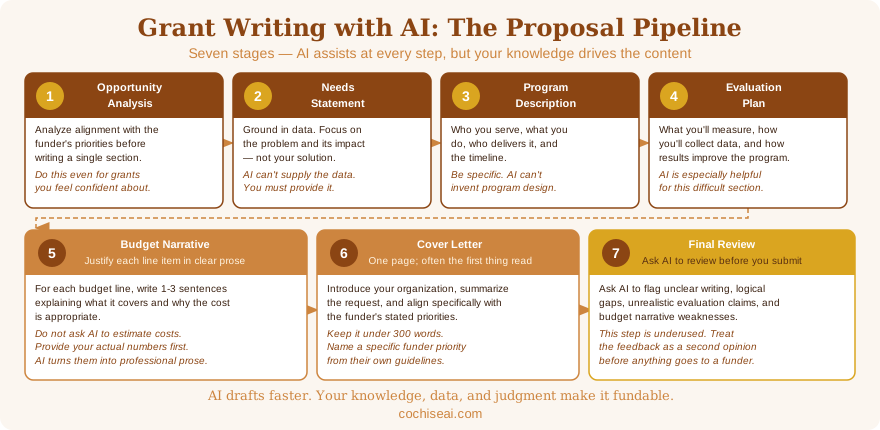
Before You Start: Understanding the Opportunity
Before writing a single section, use AI to help you analyze the funding opportunity and think through alignment between your programs and the funder's priorities.
Prompt: Funding Opportunity Analysis
You are a nonprofit grant consultant helping a small organization evaluate a funding opportunity. Here is the grant description or RFP summary: [paste the key text from the funder's guidelines, priorities, or RFP]. Our organization, [organization name], [describe your mission and main programs in two to three sentences]. Based on this information, help me answer three questions: (1) How well does this funding opportunity align with our work? (2) What aspects of our programs are the strongest match for this funder's stated priorities? (3) What gaps or weaknesses might a reviewer notice in our application, and how could we address them?
This analysis step is worth doing even for grants you feel confident about. Reviewers read dozens of proposals; knowing how your work maps to the funder's language before you write saves revision time later.
The Needs Statement
The needs statement explains why the problem your program addresses is serious, urgent, and present in your community. It should be grounded in data and focused entirely on the problem, not your solution. Reviewers read many vague needs statements; specific, local, and well-sourced ones stand out.
What to prepare before prompting: Gather any relevant data points you plan to use — local statistics, state or federal data, recent reports, or figures from your own intake records. AI can help you weave these into compelling prose, but it cannot supply the data for you.
Prompt: Needs Statement
You are a professional grant writer for small nonprofits. Write a needs statement for a grant proposal. Our organization, [organization name], serves [describe your target population] in [geographic area, e.g., "Cochise County, Arizona"]. The problem we are addressing is: [describe the problem clearly in two to three sentences]. Here are the data points and evidence I want to incorporate: [list your statistics, sources, and any local context, e.g., "According to the 2024 Arizona Report Card, 38% of third graders in our district read below grade level" or "Our own intake data shows a 22% increase in requests for emergency food assistance over the past two years"]. Write a compelling, evidence-based needs statement in two to three paragraphs, approximately 200 to 250 words. Use a formal tone appropriate for a grant application. Focus only on the problem and its impact on the people we serve. Do not describe our programs or proposed solutions.
The Program Description
The program description explains what you will actually do with the grant funding. It should cover your approach, activities, timeline, and the staff or partners responsible. Good program descriptions are specific and logical — a reviewer should be able to picture how the program runs.
What to prepare before prompting: A clear summary of your program in plain language. The more specific you are about how the program works, who does what, and over what timeline, the better the output. Do not expect AI to invent program design; it needs to come from you.
Prompt: Program Description
You are a professional grant writer. Write the program description section of a grant proposal. The program is called [program name] and is operated by [organization name]. Here is how the program works: [describe your program in plain, detailed language — who it serves, what activities it involves, how often, over what period, and who delivers the services]. The program serves [number] participants per [year/cycle]. Key staff involved include [describe roles, not names, e.g., "a full-time program coordinator and two part-time case managers"]. Partners include [list any partner organizations and their roles, or write "none"]. Write a program description of approximately 300 to 350 words in formal paragraph form. Organize it around what we do, how we do it, and what results participants can expect. Use clear, concrete language. Avoid jargon.
The Evaluation Plan
Funders want to know how you will measure success. The evaluation section describes what data you will collect, how you will collect it, and how you will know the program is working. Many small nonprofits find this section difficult to write; AI is especially helpful here because it can suggest reasonable, realistic evaluation approaches based on the type of program you describe.
Prompt: Evaluation Plan
You are a nonprofit program evaluator helping a small organization write the evaluation section of a grant proposal. Our program is [program name], operated by [organization name]. Here is a summary of what the program does and what outcomes we expect: [paste or summarize your program description and intended outcomes]. We are a small organization with [describe your data capacity, e.g., "one staff member who handles data collection using a spreadsheet" or "a basic case management database"]. Write an evaluation plan of approximately 200 to 250 words suitable for a grant proposal. Include: the specific outcomes we will measure, the data we will collect and how, the timeline for data collection and review, and how we will use findings to improve the program. Keep the approach realistic for a small organization. Use formal grant writing language.
The Budget Narrative
Most grant budgets include a narrative that explains and justifies each line item. This section does not need to be long, but it must be clear and complete. Reviewers use the narrative to verify that you have thought through how the funds will be spent and that the costs are reasonable.
What to prepare before prompting: Your actual budget numbers. Do not ask AI to estimate costs. Enter the figures you have already determined, and use AI to turn them into clear explanatory prose.
Prompt: Budget Narrative
You are a nonprofit grant writer helping draft the budget narrative section of a grant proposal. Below is our budget for this grant, organized by category. For each line item, write one to three sentences explaining what it covers and why the cost is appropriate. Use formal grant writing language. Here is the budget: [list your budget line items and amounts, e.g., "Program Coordinator (0.5 FTE): $22,500 — covers 50% of salary for one full-time equivalent position. Benefits (25%): $5,625. Supplies: $1,200 — includes [describe what supplies]. Travel/mileage: $800 — estimated [X] miles at the IRS reimbursement rate for [describe travel purpose]." Continue through all your line items]. Write a clean, professional narrative that a grant reviewer can follow easily.
The Cover Letter
A strong cover letter introduces your organization, summarizes the request, and signals that you understand the funder's priorities. It is often the first thing a program officer reads. Keep it to one page.
Prompt: Cover Letter
You are a nonprofit development professional writing a cover letter for a grant proposal. We are submitting a proposal to [funder name], requesting [dollar amount] to support [program name]. Our organization, [organization name], [describe your mission in one sentence]. Our proposed program will [describe the core activity and intended impact in one to two sentences]. This request aligns with [funder name]'s stated priority of [mention a specific funder priority from their guidelines]. Write a professional one-page cover letter addressed to [contact name or "the Grants Review Committee"]. The letter should introduce our organization, summarize the request, explain the alignment with the funder's priorities, and close with a brief expression of interest in further conversation. Keep it under 300 words. Use a formal but approachable tone.
Final Review: Checking Your Draft
Once you have a complete draft, AI can help you review it for consistency, clarity, and common grant writing weaknesses before you submit. This is one of the most underused applications of AI in grant writing.
Prompt: Proposal Review
You are an experienced grant reviewer evaluating a nonprofit's grant proposal. Please review the following proposal draft and give me honest, specific feedback. I want to know: (1) Where is the writing unclear, vague, or hard to follow? (2) Are there any logical gaps — claims that are made without evidence or steps that are not explained? (3) Does the evaluation plan seem realistic and measurable? (4) Is the budget narrative clear and does it justify the costs? (5) What are the two or three most important things I should strengthen before submitting? Here is the proposal: [paste your full proposal draft].
When you receive the feedback, treat it as a second opinion. You do not have to accept every suggestion, but any section flagged as unclear probably deserves another look before it goes to a funder.
Putting It All Together
AI works best in grant writing when you treat it as a skilled writer who needs clear instructions and your source material. The knowledge about your programs, your community, and your outcomes lives with you. Bring that knowledge to each prompt, and AI can help you express it in polished, compelling grant language far faster than starting from a blank page.
For shorter, ready-to-use prompts you can apply right away, see the 10 Ready-to-Use AI Prompts for Nonprofits, which includes needs statement and program description prompts in a more condensed format. And for guidance on what client and program information is safe to include when you are writing about your participants, see What to Share with AI (and What to Keep to Yourself).
If you would like hands-on help with grant writing using AI, or want to build your team's capacity to use these tools effectively, Cochise AI offers training and consulting for nonprofits and educational organizations. Reach out through the contact form to start a conversation.