A well-written prompt will get you better output from an AI tool. But writing good prompts is one skill among several. True AI fluency means knowing when to use AI, how to communicate with it clearly, whether to trust what it gives you, and how to keep those habits sharp over time. That's a bigger picture than any single prompt framework captures.
A Framework You May Already Know
If you've taken the Power Prompting workshop or read the Writing Better Prompts post here, you're familiar with the 4-D prompt method: Define, Describe, Direct, and Deliver. That framework is built around the structure of a single, well-constructed prompt. You define a role for the AI, describe your context, give it a specific task, and specify how you want the answer formatted.
It works well. People who use it consistently get noticeably better output than people who don't. But it was designed to answer a specific question: how do I write a better prompt right now? It doesn't address the broader question of how to work with AI effectively over time.
A Wider View: The Four Pillars of AI Fluency
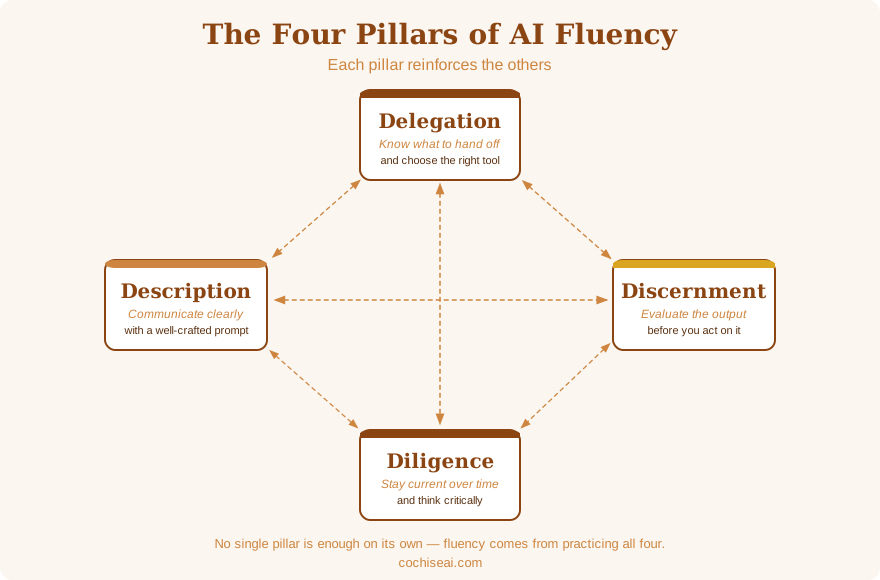
Anthropic, the company behind the Claude AI tool, approaches AI fluency differently. Their curriculum describes four pillars that together define what it means to be genuinely skilled at working with AI, not just occasionally capable of producing a useful result.
Delegation: Knowing What to Hand Off and to Whom
The first pillar is deciding which tasks belong to AI and which belong to you. Not every task benefits from AI involvement. Some tasks require human judgment, lived experience, or relational knowledge that no AI has. Others are exactly the kind of repetitive, information-heavy work that AI handles well and that would take you far longer to complete on your own.
But Delegation has a second dimension that often gets overlooked: choosing the right AI tool for the task. AI tools are not interchangeable. Some are built for long-form writing and nuanced reasoning. Others specialize in image generation, data analysis, audio, or video. Using a writing-focused tool to generate a complex infographic, or an image tool to draft a grant proposal, will get you a mediocre result at best.
A practical example: recent articles on a Tombstone history site required both well-researched narrative writing and a detailed process infographic. The two tasks went to two different AI tools, each chosen because it was genuinely suited to that kind of output. That's Delegation done well: not just deciding whether AI should be involved, but deciding which AI is right for this specific job.
Delegation is a thinking skill. A fluent AI user doesn't reach for the nearest tool out of habit. They make a deliberate choice: is this a task where AI adds real value, and if so, which tool is actually the right one for it?
Description: Communicating Clearly
The second pillar is communicating your needs in a way the AI can act on. This is where prompt-writing skills live. The 4-D method (Define, Describe, Direct, Deliver) is a practical tool for exactly this pillar. If you can describe what you need clearly and completely, you'll get better results. If you leave the AI guessing, it will fill in the gaps on its own, and those gaps may not match what you had in mind.
Description is where most AI training focuses, because it's the most tangible skill to teach. But it's worth noting that strong description skills don't help much if you've skipped Delegation. If you're asking the AI to do something it fundamentally isn't suited for, a well-structured prompt won't save you.
Discernment: Evaluating What You Get Back
The third pillar is perhaps the most underemphasized in AI training: critical evaluation of the output. AI tools produce confident, fluent, well-formatted text. That confidence doesn't mean the content is accurate. AI can and does state incorrect facts, miss important nuances, or produce output that sounds right but isn't.
Discernment means reading AI output the way a careful editor reads a draft. You look for claims that need verification. You notice when the tone doesn't quite fit your audience. You catch the places where the AI made an assumption that doesn't match your situation. You don't accept the output wholesale; you evaluate it and improve it with your own knowledge and judgment.
This matters especially for nonprofits and schools, where the people receiving your communications have a reasonable expectation of accuracy and authenticity. A grant proposal with an unverified statistic, or a student handout with a factual error, reflects on your organization regardless of how it was written.
Diligence: Staying Engaged Over Time
The fourth pillar is the long game. AI tools change quickly. The tool you learned six months ago may have new capabilities, updated policies, or different limitations today. A commitment to AI fluency means staying curious, keeping your skills current, and continuing to think critically about how and when you use these tools.
Diligence also means staying attentive to the broader questions around AI: privacy, accuracy, bias, and the appropriate boundaries of AI involvement in decisions that affect real people. These aren't abstract concerns. They come up in practical situations for anyone using AI in organizational work.
How the Two Frameworks Fit Together
Think of the two 4-D frameworks as operating at different levels. The Delegation, Description, Discernment, and Diligence framework describes what it means to be AI-fluent as a general capability. The Define, Describe, Direct, and Deliver framework is a practical tool for one part of that picture, specifically for the Description pillar.
If you can write a strong 4-D prompt, you're well-equipped for Description. But are you making deliberate choices about which tasks to delegate? Are you evaluating the output critically before acting on it? Are you keeping your knowledge of these tools current as they evolve? Those questions belong to the broader framework, and they matter just as much as the quality of any individual prompt.
Neither framework is a substitute for the other. They address different parts of the same goal: using AI in a way that genuinely serves your work, your organization, and the people you're trying to help.
A Practical Starting Point
If you're already using the prompt-writing 4-D method, the easiest next step is to start paying deliberate attention to the other three pillars. Before you open an AI tool, spend a moment on Delegation: is AI actually the right choice here? After you get a response, spend a moment on Discernment: what in this output needs verification or adjustment? And periodically, return to Diligence: what has changed about these tools recently, and what am I still assuming that may no longer be accurate?
Small habits practiced consistently add up to genuine fluency. You don't have to overhaul how you work all at once.
Getting Help
If your organization is working on building AI skills across a team, not just for individual users, that kind of training is exactly what Cochise AI supports. I work with nonprofits and schools in Cochise County to help staff develop practical, sustainable AI habits. Use the contact form to start a conversation. No obligation, no sales pitch.